
Vestibular Rehabilitation Therapy (VRT): What It Is, Exercises and What to Expect
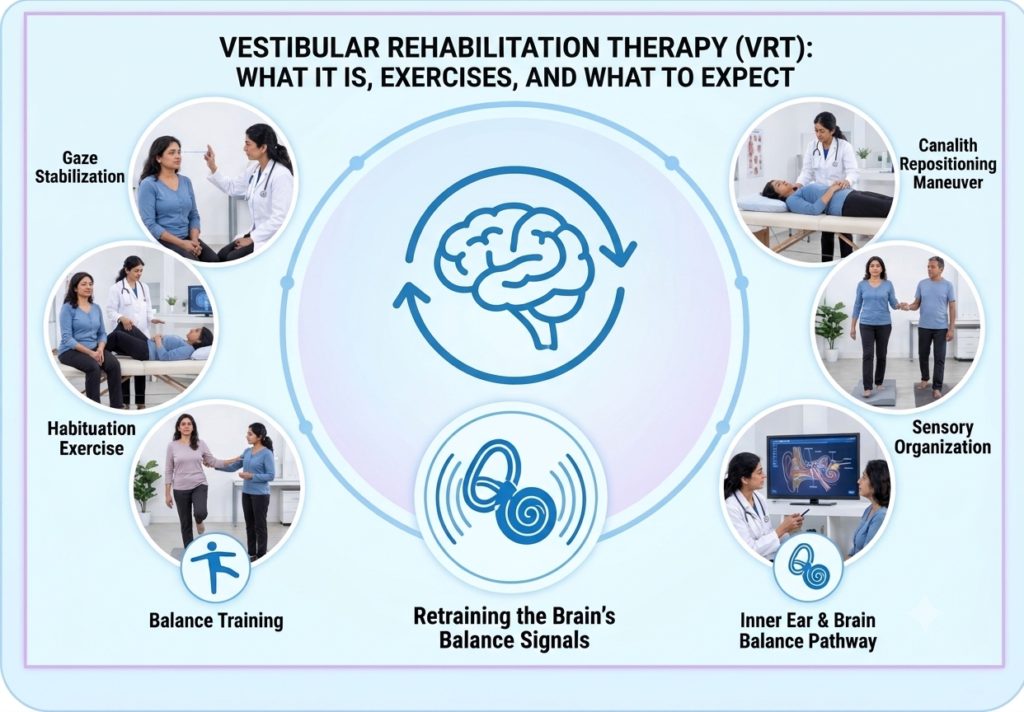
Dizziness. A constant sense of being off-balance. The room spinning when you roll over in bed. These aren’t symptoms people just live with and if you’ve been dealing with any of them, VRT may be something your doctor has already mentioned.
So what is it, really?
Vestibular Rehabilitation Therapy is an exercise-based treatment, but not the kind you’d find on a fitness app. It’s specifically designed to address problems with the balance system the network of inner ear structures and brain pathways that keep you oriented in space.
When that system breaks down, ordinary things get hard. Turning your head too fast. Getting up from a chair. Walking through a busy room. Things most people do without thinking.
VRT works by giving the brain the right kind of input, repeatedly, until it gets better at making sense of the signals it’s receiving. It’s not about masking symptoms. It’s about changing how the nervous system responds.
Why VRT Gets Recommended
Most people who end up in VRT have been dealing with one or more of these:
Spinning sensations or vertigo
Feeling unsteady on their feet
Dizziness triggered by head movement
Trouble focusing their vision while moving
Sensitivity to motion
A general sense of being off-kilter
Falls, or near-falls that are happening more often
The aim is straightforward: bring those symptoms down, and help you move through daily life without second-guessing every step.
What makes VRT different from general exercise is that it’s built entirely around what’s causing your specific symptoms. Two people with dizziness can end up on completely different programmes.
Who Does It Help?
BPPV
Probably the most common cause of vertigo. Rolling over in bed, tilting your head back, bending down and suddenly the room is spinning. Repositioning manoeuvres combined with specific exercises can resolve this quite effectively.
Ménière's Disease
The vertigo attacks get a lot of attention, but many people with Ménière's struggle with balance even on their better days. VRT helps with that in-between instability and trains the brain to cope better with the fluctuations the condition causes.
Labyrinthitis and Vestibular Neuritis
Both hit fast and hard sudden intense dizziness, nausea, the works. Once the worst of it settles, VRT steps in to support recovery and help rebuild confidence in movement.
Stroke-Related Balance Problems
Some strokes disrupt the brain areas responsible for balance and coordination. VRT can help recover function, improve stability, and support greater independence over time.
Central Vestibular Disorders
MS, traumatic brain injury, and other neurological conditions can cause balance symptoms that stick around. These cases need neurologist involvement because the problem originates in the central nervous system, not the inner ear alone. The approach is different.
How It Works
There’s a term for what happens in the brain during VRT: vestibular compensation. Your brain has a real capacity to reorganise itself when given consistent, targeted input. Over time, it gets better at combining information from the inner ear, eyes, muscles, and joints into something coherent.
The exercises used depend on what’s driving the symptoms. But there are a few core categories.
- Gaze StabilisationExercises that train your vision to stay focused while your head is moving. Helpful when walking through busy environments feels visually overwhelming.
- Habituation Exercises Deliberately doing movements that trigger symptoms, in a controlled way, so the brain gradually stops overreacting to them. Counterintuitive, but effective.
- Balance RetrainingBuilding stability during standing, walking, and position changes. The bread and butter of most programmes.
- Canalith Repositioning For BPPV specifically. Guided head movements that shift displaced crystals in the inner ear back where they belong.
Your programme will be a mix of whatever’s actually relevant to your diagnosis. Nothing gets thrown in for the sake of it.
What Patients Actually Notice
The benefits that tend to matter most to people:
- Dizziness and vertigo becoming less frequent and less intense
- Steadier walking and better coordination
- Getting visual focus back during movement
- Feeling less anxious about moving around
- Lower fall risk
- Returning to things they’d quietly stopped doing
That last point comes up a lot. People start avoiding stairs, crowds, driving, social situations. VRT often marks the point where that starts to reverse.
How Long Does It Take?
For most inner ear conditions, some improvement shows up within a few weeks. Real, noticeable progress tends to happen over six to eight weeks.
For conditions involving the brain, the timeline stretches. Months, sometimes. That's not a failure of the treatment it just reflects how much the brain needs to reorganise.
What influences recovery: the diagnosis itself, how severe things are, how consistently the exercises get done, and overall health. Gradual progress is normal. Regular check-ins help keep the programme calibrated to where you actually are.
This Isn't Something You Can DIY
There's no shortage of balance exercises online. Some are harmless. But VRT isn't a playlist of exercises it's a clinical process.
Before any exercise is prescribed, the cause of the symptoms needs to be understood. Inner ear problem? Brain-related? Visual system? A mix? Each of these needs a different approach. Treating them the same way doesn't work and can sometimes make things worse.
This matters even more when the underlying issue is neurological. A stroke, MS, a brain injury these aren't conditions where a generic balance programme is appropriate. Getting the diagnosis right is half the work.
Dr Prabash's Approach
Dr Prabash's practice focuses on vertigo, dizziness, and balance disorders. Every patient starts with a thorough neurological assessment the goal being to understand exactly what's causing the symptoms before anything else.
From there, the rehabilitation plan reflects the individual: their diagnosis, their lifestyle, what they're trying to get back to. The measure of success isn't just fewer symptoms. It's restored confidence, better mobility, and a meaningful improvement in day-to-day life.
Frequently Asked Questions
What is VRT?
A structured, exercise-based programme that helps reduce dizziness, improve balance, and retrain the brain to handle vestibular disruption better.
What conditions does it treat?
Vertigo, BPPV, Ménière’s disease, labyrinthitis, vestibular neuritis, stroke-related balance problems, and various neurological conditions affecting balance.
What exercises are involved?
Gaze stabilisation, habituation exercises, balance retraining, and canalith repositioning for BPPV. The mix depends on the diagnosis.
Does it help with vertigo specifically?
Yes. It’s one of the more effective approaches for reducing vertigo symptoms and improving balance function.
How is treatment delivered?
A combination of supervised sessions, a home programme, and regular reassessment as things change.
How quickly does it work?
Some patients notice a difference within weeks. Others take longer. It genuinely depends on the underlying condition.
Can it help with Ménière's disease?
Yes particularly for the balance problems that persist between episodes.
What about after labyrinthitis?
Once the acute phase passes, VRT is commonly used to rebuild balance and restore confidence in movement.
Can it help neck pain?
Sometimes, when neck symptoms are linked to how the person has been moving or compensating. It depends on what’s going on.
Why does a neurologist need to be involved?
Because balance problems don’t always come from the inner ear. A neurologist can identify whether the brain, the vestibular system, or something else is the source, and guide treatment accordingly.
Before Your First Appointment
Coming in prepared makes the whole consultation more useful. Here’s what to think about: