
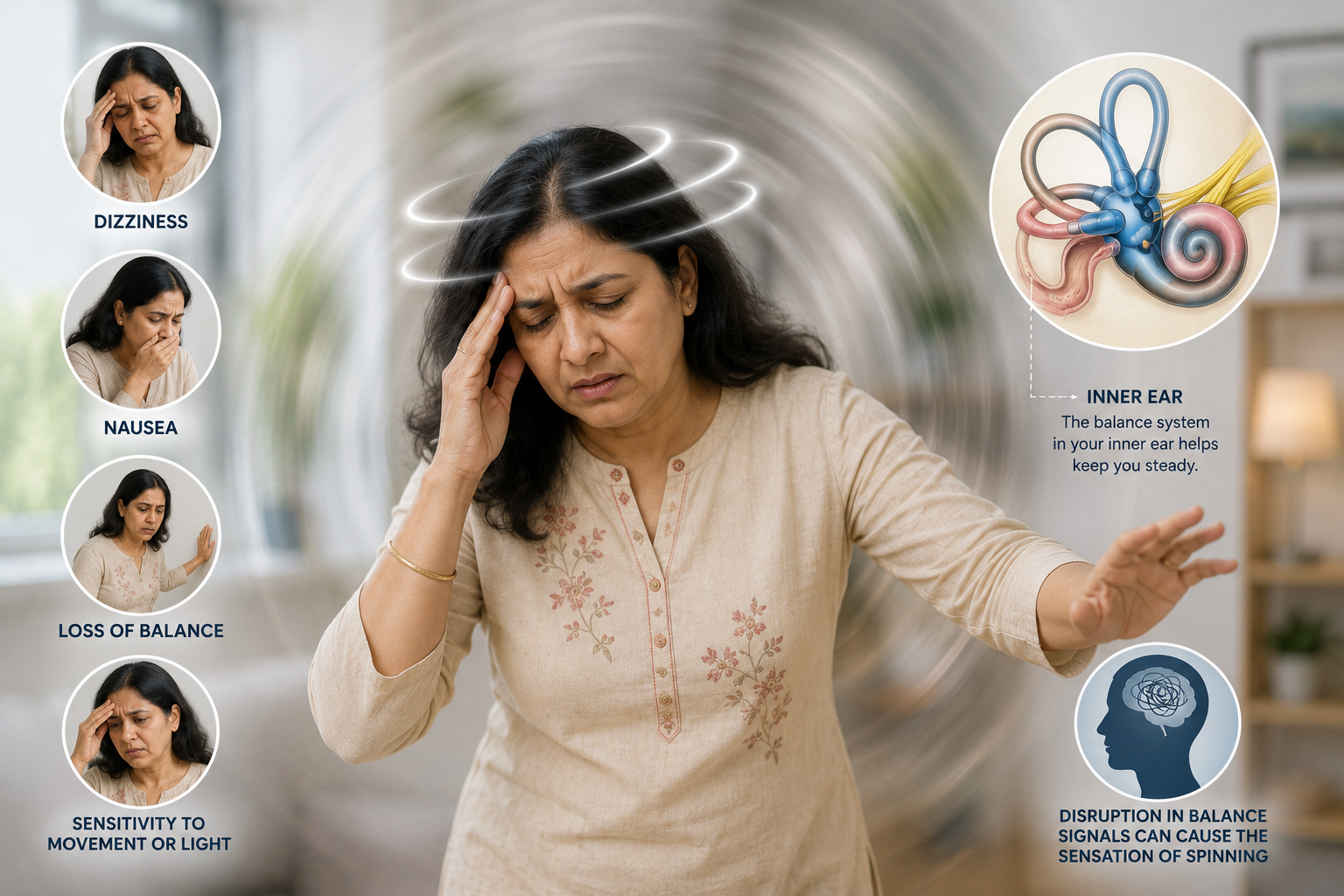
Understanding Vertigo: Why the World Feels Like It’s Spinning
There’s a difference between feeling unsteady and feeling like the world is moving around you.
Most people use the word “dizziness” to describe both. But when someone says the room is spinning, or that they feel like they’re being pulled in one direction even while standing still, it points to something more specific. It points to vertigo.
So, what is vertigo really? And why does it feel so disorienting?
Not Just Dizziness
One of the most common questions patients ask is about vertigo vs dizziness. The distinction matters.
Dizziness can feel like lightheadedness or a lack of balance. Vertigo, on the other hand, creates a clear illusion of movement. Either you feel like you are spinning, or the environment around you is.
This difference is not just about language. It reflects how the brain is processing signals from the body. Vertigo usually points to a problem in the system that controls balance, rather than a general sense of unease.
Where Vertigo Comes From
To understand why vertigo happens, it helps to look at how balance works.
The body depends on three main inputs:
- The inner ear
- Vision
- Signals from muscles and joints
The inner ear plays a central role. It detects head movement and sends signals to the brain. The brain then combines this with visual and body input to maintain orientation.
When these signals do not match, the brain struggles to interpret position. That mismatch is what leads to the sensation of vertigo.

Common Vertigo Causes
There isn’t a single explanation for all cases. Vertigo causes can vary, but a few patterns are seen more often.
One of the most common is positional vertigo, also known as benign paroxysmal positional vertigo. This happens when small crystals in the inner ear shift out of place. The result is brief episodes of spinning, often triggered by turning in bed or looking up.
Other causes include inflammation of the inner ear, migraine-related changes, or less commonly, conditions affecting the brain.
Patients often ask about triggers beyond the ear. Questions like can anxiety cause vertigo or can acidity cause vertigo come up frequently. Anxiety can heighten the sensation and make episodes feel more intense. Acidity is less likely to be a direct cause, but discomfort can sometimes be misinterpreted as imbalance.
In women, hormonal changes and migraines may play a role in certain cases, which is why discussions around causes of vertigo in women are becoming more common.
What a Vertigo Episode Feels Like
A vertigo attack can be brief or last longer, depending on the cause.
Common vertigo symptoms include:
- A spinning sensation
- Unsteadiness
- Nausea
- Difficulty focusing
Some people also report symptoms linked to neck movement, often described as cervical vertigo symptoms, though this remains a debated area.
The experience can vary. For some, it lasts seconds. For others, it may continue for hours. This often leads to questions like how long does vertigo last, and the answer depends on the underlying condition.
Is Vertigo Dangerous?
A common concern is: is vertigo dangerous?
In many cases, it is not life-threatening. But that does not mean it should be ignored. The main risk comes from falls, especially if balance is affected during an episode.
More importantly, vertigo is a symptom. Recurrent episodes may point to an underlying issue that needs attention.
Diagnosis: Understanding the Pattern
There is no single test that explains every case of vertigo. Diagnosis depends on recognising patterns.
Doctors look at:
- When symptoms occur
- What triggers them
- How long they last
Patients often ask how to diagnose vertigo or even how to tell which ear is causing vertigo. Specific clinical tests help identify the source, especially in positional vertigo.
This process is less about one result and more about connecting the pattern of symptoms.
Treatment: Not One-Size-Fits-All
When it comes to vertigo treatment, the approach depends on the cause.
For positional vertigo, simple repositioning maneuvers can be very effective. These help move the displaced crystals back into place.
In other cases, treatment may involve medication, lifestyle changes, or balance exercises. This is where questions like what is the best treatment for vertigo or what is the best medication for vertigo come in. There is no single answer that applies to everyone.
Many people also ask:
- how to stop vertigo
- how to stop vertigo fast
- how to cure vertigo permanently
Some forms, like positional vertigo, can be treated well. Others may need ongoing management.
For those looking for home-based approaches, how to cure vertigo permanently at home is a common search. While certain exercises may help, proper diagnosis remains important.
Recovery and Long-Term Outlook
One of the most important questions patients ask is: can vertigo be cured?
In many cases, yes. Especially when the cause is identified early.
Others ask, is vertigo curable or can vertigo be cured completely. The answer depends on the type. Some conditions resolve fully. Others improve over time with the right approach.
Recovery is not just about stopping episodes. It is also about restoring confidence in movement. Balance exercises and gradual exposure to motion play a role here.
When to Seek Help
Occasional vertigo may not need urgent care. But repeated or severe episodes should not be ignored.
If symptoms affect daily life, or if there are additional signs like hearing changes or persistent imbalance, it is worth getting evaluated.
Many people begin with a search like vertigo doctor near me or wonder which doctor to consult for vertigo. A specialist familiar with balance disorders can help identify the cause and guide treatment.
A Final Thought
Vertigo is unsettling because it affects one of the most basic functions we rely on—our sense of orientation.
It changes how we move, how we trust our body, and how we interact with space.
But in most cases, it is not random. There is a pattern. There is a reason. And once that is understood, the condition becomes far more manageable than it first appears.